

Effective engagement starts with gaining a deep understanding of the people important to your organization: their interests, giving or spending history, financial capacity, and likelihood to engage. WealthEngine brings these signals together to help you determine which donors, clients, and prospects warrant deeper research and personalized outreach.
What Are WealthEngine Scores and Ratings?
WealthEngine presents visual scores and ratings that summarize key indicators on an individual profile, including Propensity to Give (P2G), net worth, income, real estate holdings, estimated giving capacity, recorded donations, and connections. Together, these indicators provide a quick way to compare prospects and prioritize the people who may represent the strongest opportunities.
These scores and ratings provide a directional view based on available data and modeled estimates. They should be used as a starting point for segmentation, qualification, and further research, not as definitive statements about an individual’s finances, behavior, or future actions.
WealthEngine Scores and Ratings: Visual Breakdown
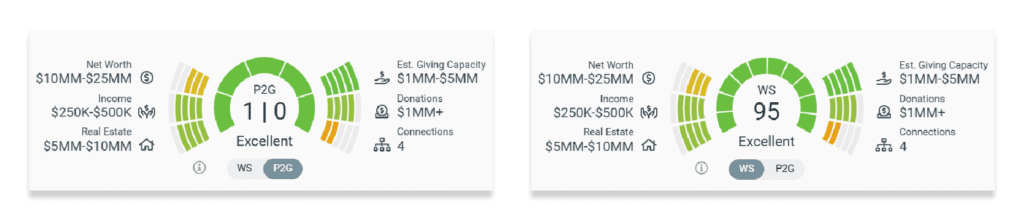
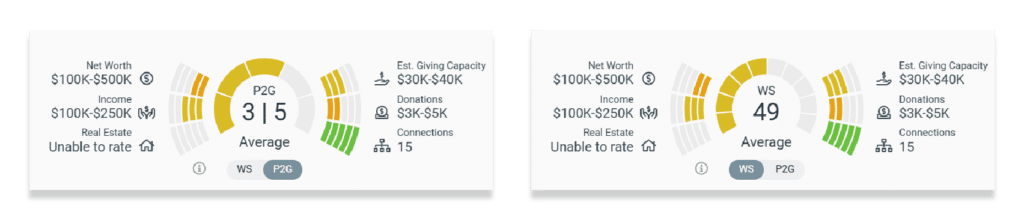
Similar to a cell phone carrier signal, the bars displayed for each parameter indicate relative strength from the low to high end of the scale. Five bars indicate that a score or rating falls near the high end of its range, while fewer bars indicate lower relative strength. This makes it easier to scan a profile and identify the indicators most relevant to your organization’s goals.
This strength is also indicated by color. The high end of the scale, four to five bars, is shown in green. The middle of the scale, three bars, is shown in yellow. The low end of the scale, one to two bars, is shown in red. Together, the bars and colors provide an at-a-glance view of the available wealth, giving, and relationship indicators on an individual profile.
Seven Key WealthEngine Indicators
1. P2G (Propensity to Give)
The Propensity to Give (P2G) score is a proprietary score that represents propensity for general philanthropic giving. It is a two-digit score. The first digit represents the overall category on a scale of one to five, while the second digit subdivides and ranks individuals within that category.
Lower scores indicate stronger relative propensity. For example, a score of 1|0 ranks ahead of 1|1, while scores within category one rank ahead of those within category two. Fundraisers can use P2G to sort a large constituent list and identify individuals who may warrant further qualification.
2. Net Worth
Net worth, as displayed in WealthEngine, indicates an estimated range in which the difference between a household’s total assets and total liabilities is likely to fall. It provides a directional view of overall wealth that can support prospect segmentation and prioritization.
When reviewing multiple profiles, the net worth rating can help identify prospects whose estimated financial capacity aligns with the donors, clients, or customers your organization is trying to reach. Because it is modeled, it should be evaluated alongside other indicators rather than treated as a verified financial statement.
3. Income
Income indicates an estimated range for an individual’s regularly accrued funds. It can provide additional context about financial capacity, particularly when reviewed with net worth, investable assets, real estate, and giving history.
Income alone does not determine how much someone will donate, invest, or spend. Instead, it helps teams develop a more complete view of the prospect and prioritize the appropriate next step.
4. Real Estate
Real estate indicates an estimated range for the total value of properties associated with an individual. Property ownership may provide useful context about overall wealth, geographic ties, and potential financial capacity.
Real estate should be treated as one capacity indicator rather than proof of liquidity or intent. Prospect researchers can combine it with other wealth and giving indicators to support deeper qualification.
5. Estimated Giving
Estimated giving capacity provides a modeled range of how much an individual may have the financial capacity to give over the next five years. The estimate considers available indicators such as assets and giving history.
For prospect researchers, this rating can help inform portfolio assignment, gift-range discussions, and further qualification. WealthEngine also allows organizations to adjust the estimated giving capacity formula within the platform to reflect their own methodology and local market conditions.
6. Donations
Donation strength indicates the value of identified charitable gifts associated with an individual. This gives nonprofits additional context about a prospect’s past philanthropic activity and can help teams identify potential major donors, upgrade candidates, or supporters whose capacity may be underutilized.
These records generally reflect major gifts large enough to be reported on a nonprofit’s website, in an annual report, or through another public source. Smaller recurring gifts, such as a monthly donation, may not appear. WealthEngine clients can upload their own giving data to create a more complete view of their audience and target their engagement more effectively.
This metric, along with estimated giving capacity, can also be valuable to wealth managers. Philanthropic activity can reveal interests that help advisors prepare more relevant conversations about charitable planning, legacy goals, or vehicles such as donor-advised funds.
7. Connections
Connection strength displays the number of familial and business connections associated with an individual. These relationships can help teams identify potential introduction paths, shared affiliations, and additional prospects within an existing network.
Turn Scores and Ratings Into a Prioritized Workflow
WealthEngine’s scores and ratings help development, advisory, and clienteling teams move from a large audience to a more focused plan of action. Teams can use the indicators to:
- Segment a database based on the criteria most relevant to the campaign
- Prioritize prospects for deeper research or portfolio assignment
- Compare capacity, propensity, giving history, and relationship context
- Identify opportunities for more relevant, personalized engagement
- Determine where additional verification or human research is needed
The goal is not to rely on a single score. It is to combine multiple signals with your organization’s own knowledge, engagement data, and professional judgment. This creates a more informed foundation for cultivating lasting donor and client relationships.
WealthEngine helps organizations screen, segment, analyze, and prioritize prospects through wealth data and modeled insights. Explore how WealthEngine can help your team focus its research and engagement efforts on the people most likely to advance your goals.
Frequently Asked Questions
What do WealthEngine scores and ratings indicate?
WealthEngine scores and ratings summarize available wealth, giving, and relationship indicators on an individual profile. They help teams compare prospects, create segments, and decide where to focus additional research and engagement.
What is the WealthEngine P2G score?
P2G stands for Propensity to Give. It is a proprietary score that ranks an individual’s relative propensity for general philanthropic giving. Lower P2G scores represent stronger relative propensity.
Are WealthEngine net worth and income ratings verified financial figures?
No. Net worth, income, estimated giving capacity, and similar values are directional estimates based on available data and modeling. They should not be treated as verified financial statements or used as the sole basis for a decision.
How should prospect researchers use estimated giving capacity?
Estimated giving capacity can help inform portfolio assignment, gift ranges, and prospect prioritization. Researchers should combine it with giving history, affinity, engagement, relationship context, and additional verification before recommending an ask.
How can wealth managers use these indicators?
Wealth managers can use the indicators to segment prospect or client audiences, identify potential expansion opportunities, prepare more relevant conversations, and better understand interests such as philanthropy or real estate.
Should organizations prioritize prospects using a single score?
No. The strongest prospecting strategies combine multiple indicators with first-party engagement data, organizational knowledge, and professional judgment. A score should guide further research, not replace it.